
Greek Vineyards by the Sea
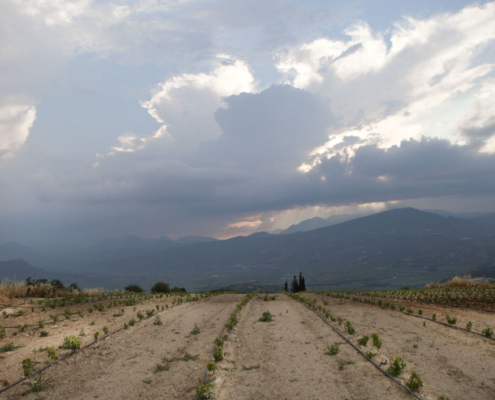
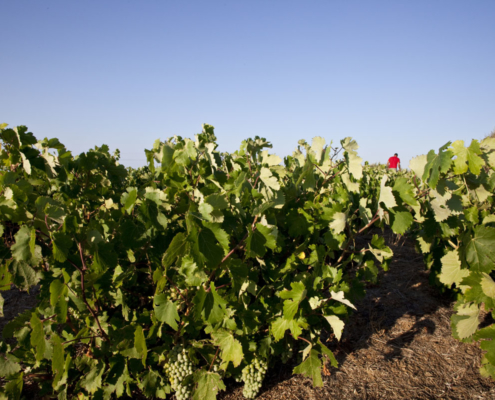
In Greece, the sea is never far from a vineyard. The country’s climate is generally mild, largely due to the strong influence of the surrounding seas. In a landscape where nearly 80% of the land is mountainous, vineyards often unfold along coastlines, on islands, and across sea-facing slopes. Here, the sea acts as a natural regulator, moderating temperatures through moisture, cooling breezes that ease summer heat, and, in some areas, higher rainfall. Freshness is better preserved, allowing wines to maintain balance and clarity even in warmer climates.
This influence is not uniform, nor does it create a single “maritime style,” but it consistently benefits the vines. Because water temperatures change more slowly than those of the land, vineyards close to the sea tend to be cooler in spring and warmer in autumn as temperatures fall. During summer, maritime breezes help retain acidity in the grapes and moderate potential alcohol, resulting in wines that feel more energetic and vibrant.
PDO Santorini (ΠΟΠ Σαντορίνη) is a clear example. This small island in the Aegean is surrounded by sea, and its vineyards benefit from persistent sea winds that temper extreme heat and slow the ripening process. The wines show tension, structure, and longevity – qualities closely linked to their coastal environment.
Further north and east, PDO Samos (ΠΟΠ Σάμος) offers another expression of sea influence. Vineyards climb steep slopes overlooking the sea, where cooling breezes help preserve the aromatic intensity and freshness of White Muscat grapes.
Beyond individual appellations, broader zones such as PGI Cyclades (ΠΓΕ Κυκλάδες) capture the shared imprint of the Aegean. Across islands like Paros and Tinos, wines tend to show brightness, subtle salinity, and textural finesse rather than weight or heavy extraction.
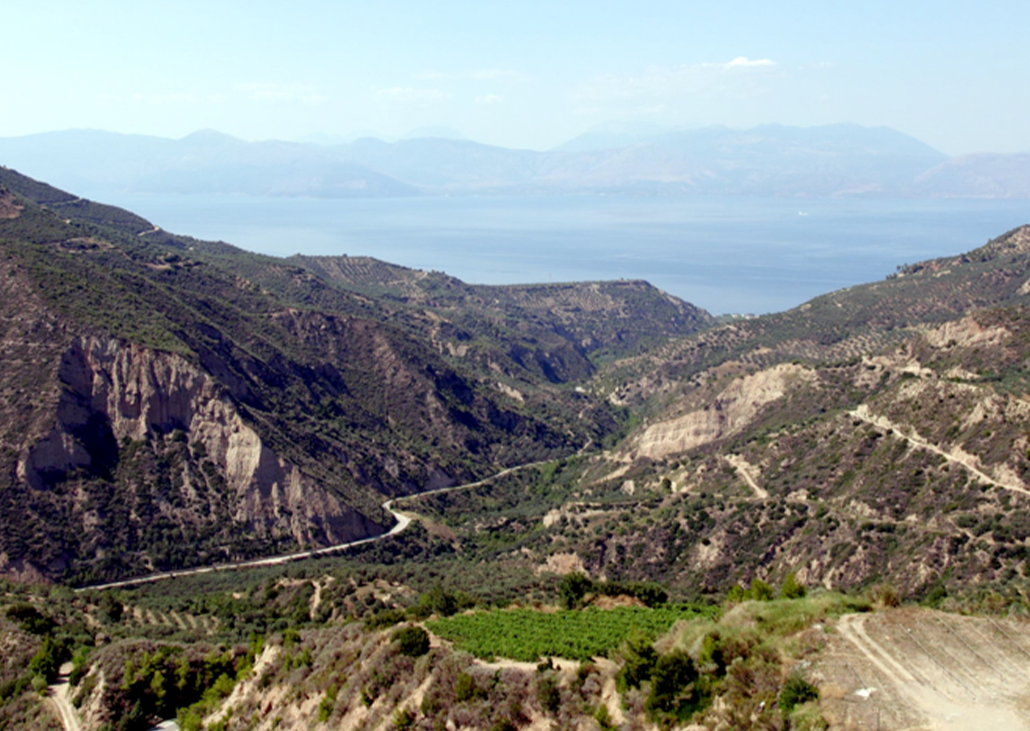
Sea influence also extends to the mainland. In the Peloponnese, parts of PGI Peloponnese (ΠΓΕ Πελοπόννησος) include coastal and sea-facing vineyards where airflow and proximity to the sea contribute to wines with aromatic lift and lively acidity. Few regions express the dialogue between land and sea more clearly than PGI Slopes of Aigialia (ΠΓΕ Πλαγιές Αιγιαλείας), where vineyards follow the natural contours inland from the Gulf of Corinth while still benefiting from the sea’s steady climatic presence. These high-altitude vines grow on steep, sea-facing slopes with northern exposure and poor, stony soils and are bright, fresh with lovely tension.
In Central Greece, PGI Atalanti Valley (ΠΓΕ Κοιλάδα Αταλάντης) benefits from its proximity to the Evoikos Gulf, where sea breezes help moderate temperatures and contribute to wines of brightness and balance. A similar dynamic appears further north in Macedonia. In PGI Epanomi (ΠΓΕ Επανομή), vineyards lie close to the Thermaic Gulf, where maritime airflows soften summer heat in what is otherwise an early-ripening region.
In Central Greece, PGI Atalanti Valley (ΠΓΕ Κοιλάδα Αταλάντης) benefits from its proximity to the Evoikos Gulf, where sea breezes help moderate temperatures and contribute to wines of brightness and balance. A similar dynamic appears further north in Macedonia. In PGI Epanomi (ΠΓΕ Επανομή), vineyards lie close to the Thermaic Gulf, where maritime airflows soften summer heat in what is otherwise an early-ripening region.